A skin tone test at home is most useful when it replaces a vague guess with a few repeatable observations. It cannot diagnose anything, and it does not need to put you in a fixed category. Its practical purpose is smaller: to show whether a foundation belongs near your neck, whether a shirt is making your complexion look clear or tired, and which colour comparisons you should make next. Good daylight and patience do more than a clever trick with wrist veins.
Decide what you want the test to answer
“What is my skin tone?” can mean several different things. You may be looking for surface depth, such as fair, light, medium, tan, or deep. You may be trying to identify an undertone: warm, cool, neutral, or olive. Or you may be deciding which colours to wear near the face. These questions overlap, but they are not interchangeable. A light complexion may have a warm, cool, neutral, or olive undertone; a deep complexion can do the same.
Choose one question for each test session. If you are matching foundation, compare your cheek, jawline, neck, and upper chest. If you are choosing clothing, use fabric near the face and ignore whether it matches your current makeup. If you are exploring seasonal color, record temperature, value, and softness separately. Trying to solve all three questions at once is how a harmless mirror exercise becomes confusing.
Separate surface depth from undertone
Surface depth is the visible lightness or depth of the skin. It can change with sun exposure, freckles, redness, and lighting. Undertone is the quieter cast that remains more stable: warm skin tends toward golden, peach, or yellow; cool skin often reads pink, rosy, or blue-based; neutral sits between them; olive can include muted yellow, green, grey, or golden notes. No single feature proves an undertone. The wrist-vein idea is popular because it is quick, but veins themselves are affected by skin thickness, lighting, and how much blue is reflecting through the skin.
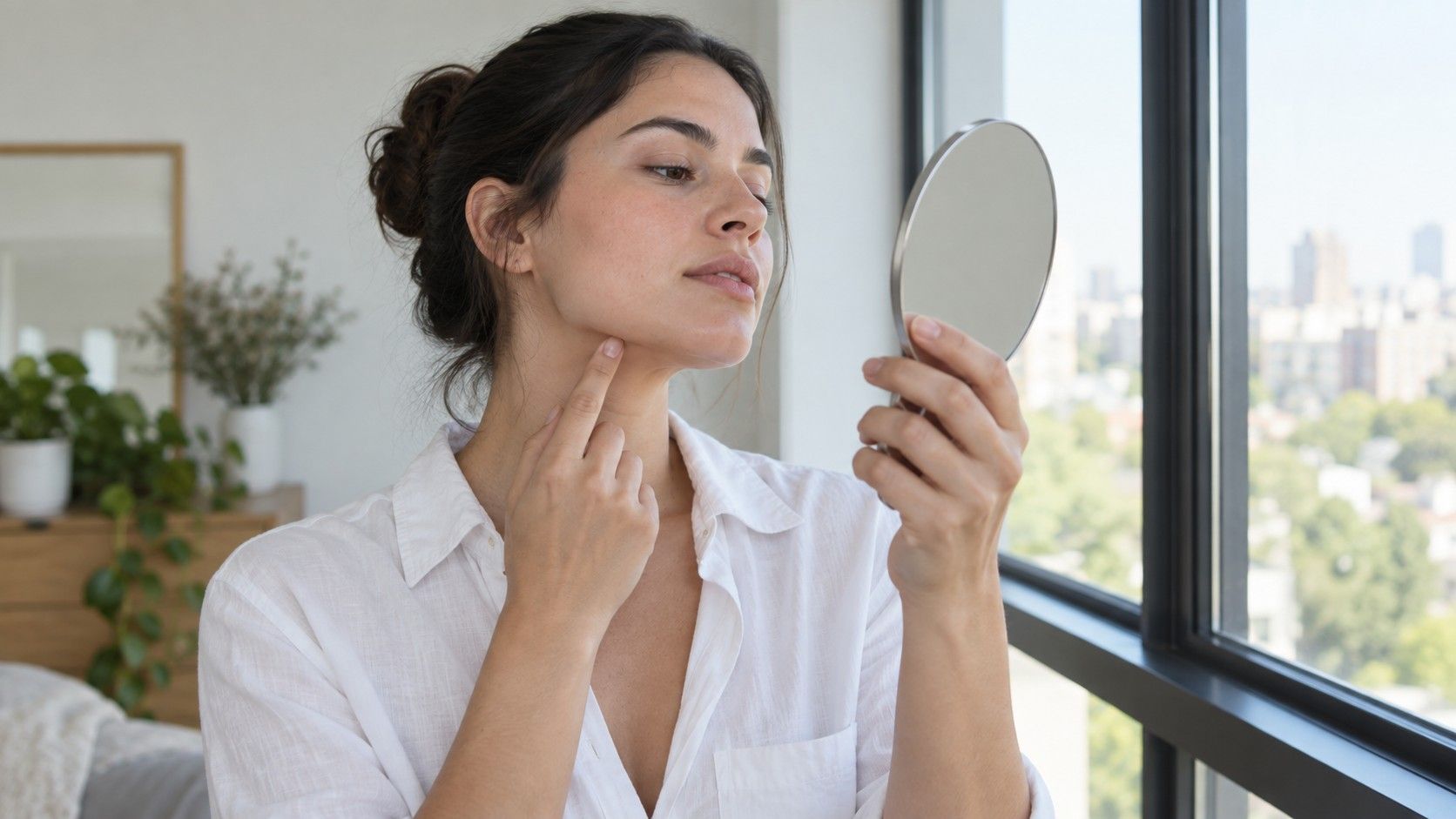
Look at the jawline rather than the centre of the face, where flushing and product residue are common. Then look at the neck. If a warm foundation turns orange against the neck and a cool foundation turns noticeably pink, your answer may be neutral or olive rather than a failure to choose. Keep the words tentative at first: “light-medium, perhaps neutral olive” is a better observation than forcing a final identity after one mirror check.
| Question | Best area to compare | Most useful clue |
|---|---|---|
| Surface depth | Jawline and neck | Whether a shade disappears after it dries |
| Undertone | Jaw, neck, upper chest | Which cast looks least separate from the skin |
| Clothing colour | Face and upper chest | Whether shadows and redness become more visible |
| Seasonal direction | Whole face in daylight | Response to warm/cool, light/deep, clear/soft pairs |
Set up window light before you use the mirror
Bathroom bulbs often add warmth from above, while overhead office lighting can make everyone look grey. For a more useful my skin tone test, stand facing a window in indirect daylight. A bright overcast day is excellent; direct sun is too harsh because it creates high contrast and strong reflected colour. Turn off coloured lamps, remove tinted glasses, and step away from a painted wall that reflects strongly onto the skin. A plain white or grey top makes the comparison easier, though it is not essential.
Use a clean mirror and bare skin where possible. If you are testing around makeup, remove only the strip along the jawline instead of rubbing the whole face. Wait a few minutes after washing or exercising so temporary redness settles. Take two unfiltered photos from the same position, one near the window and one a little farther back. The point of the photos is not to choose a shade from pixels; it is to see whether an observation remains true when you look later without the pressure of deciding immediately.
Compare fabric before relying on veins or jewellery
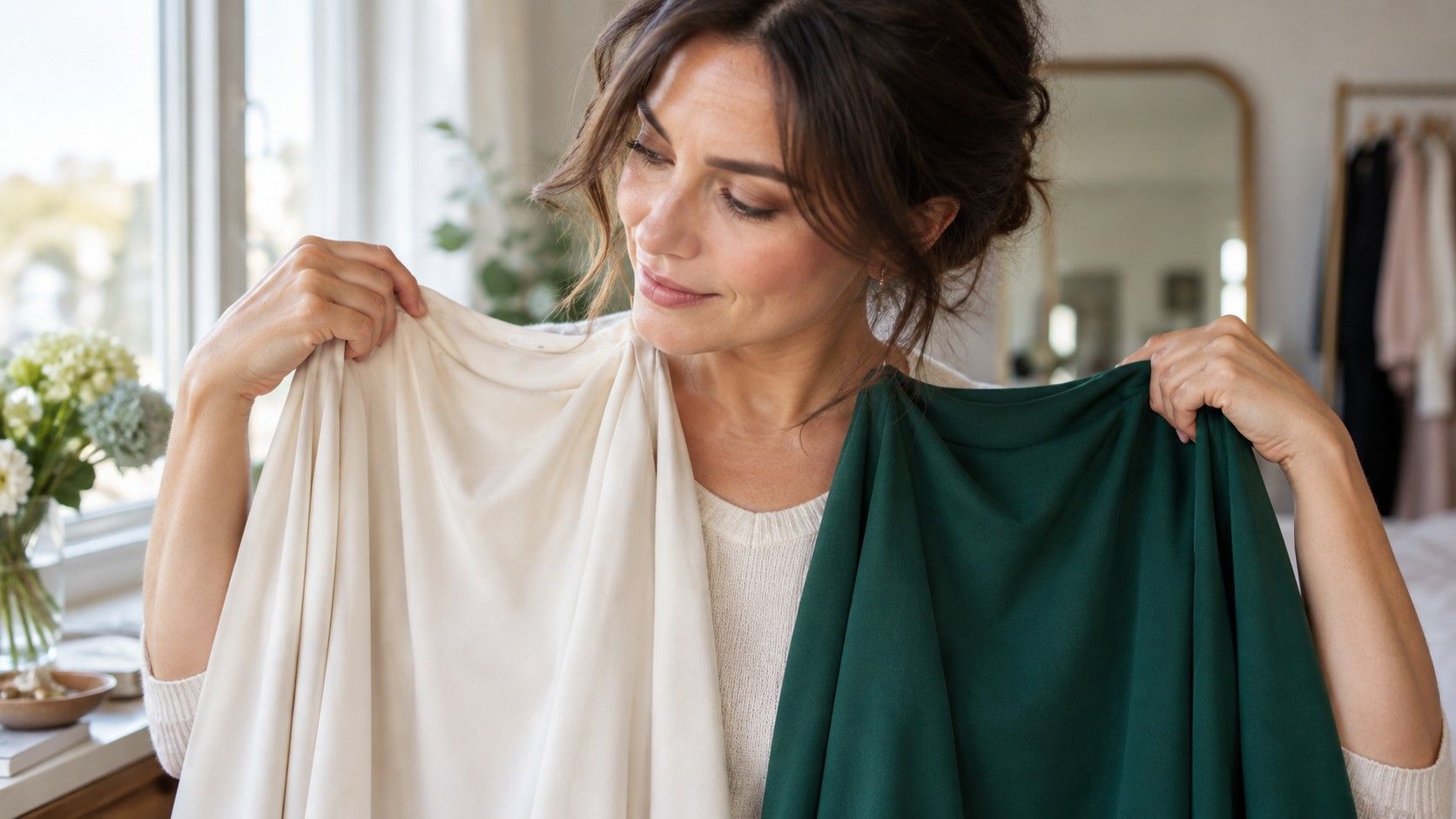
Fabric tests give the face a larger, clearer context than a small metal bracelet. Find pairs that differ mainly in temperature: cream and optic white, coral and berry, camel and cool taupe, tomato red and blue-red. Then hold each colour beneath the chin for thirty seconds. Do not ask which one looks more fashionable. Ask which one makes the lips, brows, and eyes look more defined and which one pulls attention to unevenness around the mouth.
Jewellery can support an observation, but it is a weak first test because metal is reflective and the pieces are usually small. Gold can look right because it echoes a preferred outfit, while silver can look right because it gives useful contrast. Likewise, a vein that appears green does not guarantee warmth. Treat every shortcut as one clue. When cream, coral, and warm olive all improve the face in the same light, that pattern is more persuasive than the colour of one vein.
Test foundation on the neck and give it time
For foundation, make three short stripes from the lower cheek across the jawline toward the neck. Choose adjacent depths, not three random shades: one likely match, one slightly lighter, and one slightly deeper, with undertones that represent your best guess. Leave them alone for ten to fifteen minutes. Some formulas oxidise, and a shade that looks fine at first can become orange, peach, or dull after it sets.
Check in window light from arm’s length. The best shade seems to join the neck rather than brighten the centre of the face. If none of the options work, change undertone before changing depth. A foundation that is beautifully light but too pink will remain wrong; a very warm shade that is the exact depth can still look like a stripe. Write down the brand, shade name, and what happened after drying. That tiny record prevents the same expensive mistake in the next shop.
Keep observations that stay true over several days
One test is only a snapshot. Repeat it on two or three days, especially if you are deciding on a seasonal color direction or a new foundation. Make a short note after each comparison: “soft navy better than black,” “cool berry better than coral,” or “warm beige too yellow at the neck.” Patterns are more useful than a pile of labels. If a result changes wildly, inspect the lighting and the fabrics before assuming your undertone has changed.
Your skin tone can be a practical working description, not a final answer. It may shift slightly with a tan, hair colour, clothing contrast, or a change in makeup. The stable part is the skill of comparing colours under honest light. Once you can see that a shade helps your face look awake rather than merely matching a chart, the test has already done its job.